
We Start with What
You Already Have
Not every project starts from scratch. We can join at the idea stage, when a requirements document already exists, when there's an initial UX specification, or when a prototype has been created using AI or no-code tools. We treat everything that's already been done as valuable input, learning from it to understand the goals and requirements while identifying what should be preserved, refined, or added to turn it into a complete product.
Understanding the Product
and Its Context
Before designing screens, we define what the product needs to achieve, who will use it, and which workflows, decisions, and situations it needs to support. We study the business environment, users, constraints, and existing systems to ensure the solution is tailored to your product, your organization, and the real-world context in which it operates.

Defining the Product Structure
We turn ideas, requirements, and insights into a clear, cohesive product structure. We define modules, workflows, information architecture, and the relationships between different parts of the system, while also addressing context-dependent scenarios.
Designing and Validating the Experience
We design user flows and interactions, create alternative solutions and prototypes, and evaluate them against the product goals and user needs. Our work is always grounded in research, experience, user behavior, and a deep understanding of complex products and systems.
Designing a Complete
and Consistent Product
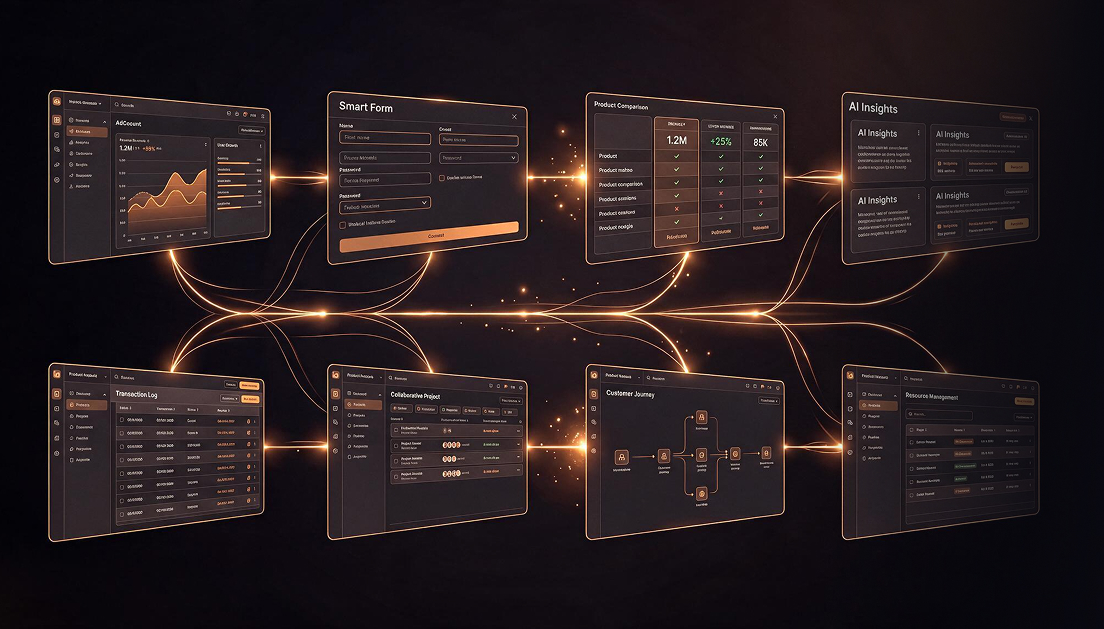
Once the product structure and workflows are defined, we design the interface and visual language. Our work includes key screens, different states, reusable components, and a Design System that keeps the product consistent as it evolves. The result is not just a collection of screens, but a structured foundation for product and development teams.
Supporting Implementation
and Maintaining Quality
Our work doesn't end when we hand over a Figma file. We continue working with your product and development teams, answering questions throughout implementation, resolving product decisions that arise along the way, and ensuring the final product stays true to the intended product logic, UX, and design. This helps maintain product quality throughout the transition from design to development.
Using AI Without Compromising Professional Judgment
We use AI tools for research, synthesis, ideation, exploring alternatives, prototyping, and design, incorporating tools such as Figma Make, Lovable, and Claude Code whenever they fit the project. These tools help us move faster, but they don't replace the need to define the product correctly, identify gaps, validate assumptions, understand the context, and make the right product decisions. The faster we can build, the more important it is to think precisely.


 Contact us